ARR Tracking Software
Your recurring revenue spreadsheet, your billing tool, and your board deck all report a different number.
DealARR calculates annual recurring revenue, MRR, NRR, and GRR from your live deal book, using one formula across every report.
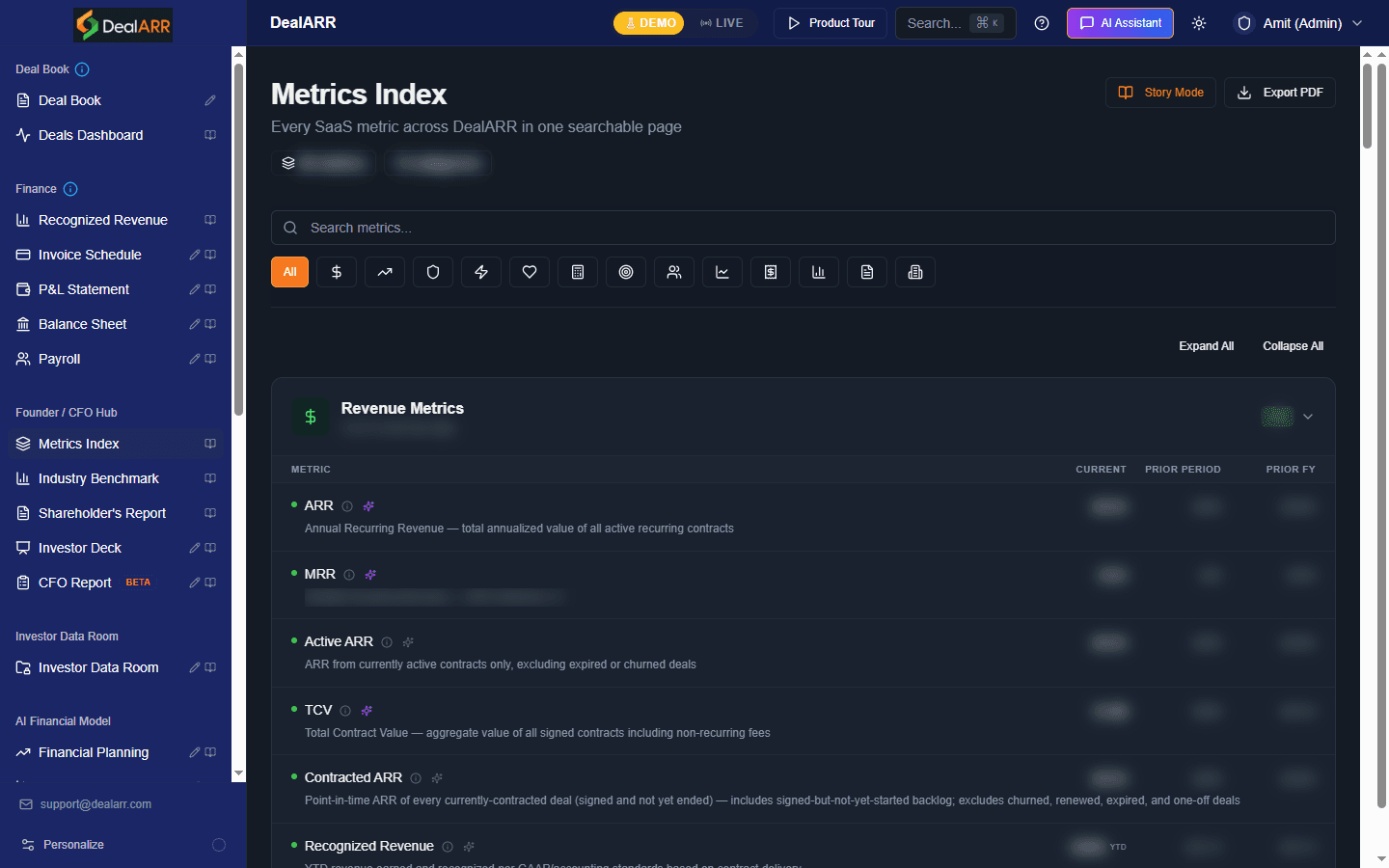
What ARR Tracking Software Does
ARR tracking software calculates annual recurring revenue from contract data and keeps that number current as contracts change. It reads each deal's value, term, and status, then excludes anything not committed. DealARR connects the result to invoices, renewals, and board reports, so one engine drives the ARR software capabilities below.
Active status check
DealARR counts active, renewed, and expanded contracts. It drops churned and terminated deals automatically, and holds drafts out of the revenue total until a customer signs.
Pro-rata and multi-year terms
DealARR annualizes partial periods from real start and end dates. It spreads multi-year revenue across the full term instead of booking the whole commitment into year one.
Expansion, contraction, churn
Upsells, added seats, and upgrades raise recurring revenue. Downgrades and cancellations lower it, and DealARR records each movement separately rather than netting them into one figure.
Multi-currency normalization
DealARR normalizes every deal into one base currency at live rates. Each deal keeps its original currency for invoicing, so ARR software reports a comparable company total.
What Good ARR Software Actually Tracks
Good ARR software tracks the movements inside the number, not just the total. It separates new business, expansion, contraction, churn, and renewal, so you see which one moved and why. A single annual figure gives direction; the breakdown gives cause. DealARR reports both for every customer in the book.
Automatic calculation
DealARR computes recurring revenue from contract value and duration rather than manual entry, handling pro-rata periods and multi-year terms under one rule.
Bridge and waterfall
The bridge shows every movement between opening and closing revenue: new business, expansion, contraction, and churn. It reports the cause, not just the delta.
MRR movement breakdown
DealARR tracks New, Expansion, Contraction, and Churn monthly revenue separately. A flat month carrying heavy churn never reads like a genuinely flat one.
NRR and GRR tracking
Net and Gross Revenue Retention come from the deal book with period-over-period comparison. Investors ask for this pair before almost anything else.
Contracted vs. recognized
Contracted revenue sits beside recognized revenue, exposing the gap that catches out companies reporting bookings as earnings.
Growth by any dimension
Read revenue and growth by customer, product, plan, segment, region, or owner. Any dimension on a deal becomes a way to report the number.
Renewal and forecast views
DealARR groups renewals into 30, 60, and 90-day windows, quantifies the revenue at risk in each, and forecasts what the book delivers next quarter.
Cohort and trend views
Month-over-month and year-over-year trends sit beside cohorts grouped by a customer's start date. These views feed the ARR reporting your board receives.
Every ARR Reporting Metric Your Board Asks For
Every ARR reporting metric here derives from the same deal data, so recurring revenue matches retention, which matches the board report. Whether you report software ARR to a board, a lender, or an auditor, one source produces all of it. DealARR tracks 96 SaaS metrics in total and surfaces them on the ARR dashboard described next.
Who Uses the DealARR ARR Dashboard
Three roles use the ARR dashboard daily: founders who own the revenue number, finance and revenue operations teams who reconcile it, and investors who audit it. SaaS companies at every stage sit behind those roles, from seed teams building a first deal book to Series B businesses needing auditable reporting.
Founders and CEOs
You see live recurring revenue, so the board report carries the number you quoted last week. You stop rebuilding the spreadsheet before a meeting, and you answer retention questions from the dashboard.
Finance and RevOps teams
Your monthly reconciliation disappears. Every metric recalculates the moment a deal changes status, value, or term, so month-end becomes a review and your CRM and billing tool stop disagreeing about customers.
Investors and boards
You receive board packs generated from one verified deal book, so revenue, retention, and the bridge never contradict each other. That consistency answers most questions about a SaaS company's growth.
Frequently Asked Questions
Common questions about ARR tracking software and how DealARR calculates recurring revenue.
What is ARR tracking software?+
How does DealARR calculate the number?+
What is the difference between ARR and MRR?+
What counts as recurring revenue?+
Is ARR the same as GAAP revenue?+
Do I have to replace my billing tool or CRM?+
How much does DealARR cost?+
Get ARR Tracking That Always Agrees
Import your deals and let DealARR calculate every recurring revenue metric for you. You get one number, one formula, and no version of the truth living in one person's spreadsheet.
Start Free Trial30-day free trial · up to 5 users · no credit card