Deal Management Software
Your CRM says the deal closed, but nobody on the sales or finance team can tell you what it did to revenue.
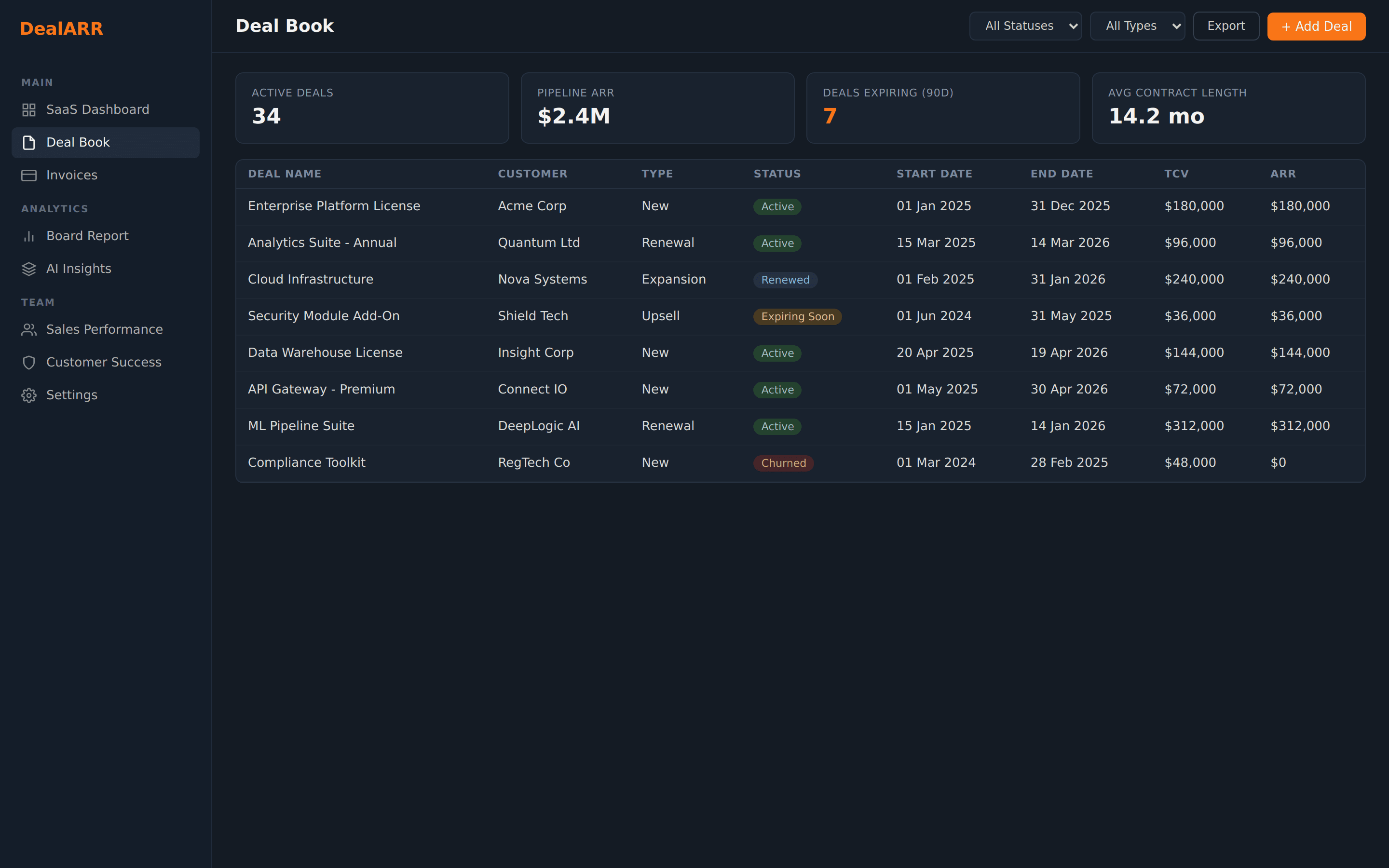
DealARR tracks every deal with its value, term, stage, and renewal date, then reports the recurring revenue, invoice schedule, and commission that deal creates.
What Deal Management Software Does
Deal management software tracks every opportunity and contract in one place, with its value, stage, owner, and key dates. Most sales teams stop there. DealARR carries each deal one step further, because every record also holds the revenue that deal creates, so deals management stops being a spreadsheet chore and starts feeding revenue reporting directly. The data behind the pipeline and the data behind the board report become the same data, which is what deal tracking software should deliver.
One record per contract
Every deal holds one record: customer, product, value, currency, term, start and end dates, owner, and status. No parallel copy lives in a side spreadsheet on someone's laptop.
Stage and status tracking
Deals move through the stages your sales team already uses. Status decides what counts, so only active, renewed, and expanded deals contribute revenue to the reported total.
Every deal carries its revenue
Deal value and term become a recurring revenue figure on the deal itself, so a closed deal immediately shows what it added to the run rate.
Renewals and expirations
DealARR tracks renewal and end dates per deal and groups them into 30, 60, and 90-day windows, so no contract lapses because it fell off a calendar.
Owner and team attribution
Every deal carries an owner, so pipeline, closed revenue, and quota attainment roll up by rep, by team, and by segment without a manual export.
Real-time recalculation
When a rep changes a deal's value, stage, or close date, every downstream number moves with it in real time. Nobody rebuilds a report to see the effect.
Deal Tracking Software That Knows the Revenue
Deal tracking software should tell you what closing a deal changed, not just that it closed. DealARR links every deal to the revenue it adds, the invoices it triggers, the revenue it will recognize, and the commission it earns. Sales teams get a live pipeline and finance teams get the revenue consequence of that pipeline, from one deal book rather than two systems that disagree by the end of every month. The solution was built for teams that already work in a CRM and need the reporting layer their CRM does not provide, without adding another set of workflows for reps to maintain.
Central deal book
One place holds every contract your sales team has sold, live or expired, so the deal book becomes the record every other report reads from.
Pipeline by stage
See open deals by stage with value and expected close date, and spot where deals collect instead of moving forward.
Deal-level revenue
Read revenue by deal, customer, product, plan, segment, or owner, because every deal carries its own contribution to the recurring total.
Renewal and expiry view
Contracts approaching renewal group by window, with the revenue at risk attached, so the renewal conversation starts in good time.
Win and loss analysis
Compare won and lost deals by size, product, segment, and rep to see what your sales team actually converts rather than what it believes it converts.
Forecast from pipeline
Forecast from live deal values, stages, and close dates, and keep committed renewal revenue separate from pipeline revenue.
Deal-linked commissions
Each closed deal shows the commission and earnings it generates, so reps and finance read one figure instead of arguing monthly.
Per-rep scorecards
Every rep gets a scorecard showing pipeline, closed revenue, and attainment against plan, so a deal review runs on real numbers.
Team and segment rollups
Deal data rolls up by team, region, and segment, so a sales leader sees where the quarter is really being won.
Stalled deal surfacing
Deals with no movement surface by time in stage, so a sales manager sees which ones need a decision rather than another status update. The insights come from deal data your reps already keep current.
At-risk revenue flags
Deals approaching renewal without engagement carry a risk flag, so the revenue exposed is visible while there is still time to act.
Works with your CRM
DealARR is not a CRM and does not try to be. It syncs with HubSpot and Salesforce, leaves the selling activity there, and reports the revenue side. Those figures drive the deal pipeline management metrics below.
Deal Pipeline Management Metrics That Matter
Deal pipeline management works only when the pipeline numbers and the revenue numbers come from the same data. Every metric here reads from the deal book, so win rate, forecast, and recurring revenue never need reconciling against each other before a Monday sales meeting. DealARR tracks 96 SaaS metrics in total, and a sales team and a finance team can read the same set without translating between two tools.
Who Uses This Sales Deal Management System
Sales leaders, revenue operations teams, and founders use this sales deal management system for the same deal data and three different questions. A sales manager asks which deals need attention, a revenue operations team asks whether the numbers tie, and a founder asks what the pipeline is worth in real revenue. One deal book answers all three in real time.
Sales leaders and managers
You see the pipeline by stage, which deals are stalling, and what each rep is tracking against quota. Deal reviews run on current numbers, so your team spends the meeting on deals that need a decision rather than agreeing what the data says.
RevOps teams
One system feeds pipeline, forecast, revenue, and commissions, so nobody stitches CRM exports to billing exports. When a deal changes, every downstream number changes with it, and month-end stops eating three days of your time.
Founders and CFOs
You know what the sales pipeline is worth in recurring revenue, not just in deal count. Closed business, renewals at risk, and forecast revenue come from one deal book, so the board number and the sales number are the same number.
Frequently Asked Questions
Common questions about deal management software and how DealARR tracks deals and their revenue.
What is deal management software?+
How is this different from a CRM?+
What are the stages of deal management?+
Can I see revenue for each deal?+
Do I have to move off HubSpot or Salesforce?+
How does deal tracking improve forecasting?+
Can I track deals by rep and team?+
How does it surface deals that are stalling?+
Does it handle renewals as well as new deals?+
How much does DealARR cost?+
Move Deals onto One Deal Management Platform
Import your deals and DealARR gives your sales team the pipeline, gives finance the revenue each deal creates, and gives both the renewals landing next quarter, from one deal management platform.
Start Free Trial30-day free trial · up to 5 users · no credit card