Revenue Recognition Software
Revenue recognition runs on a spreadsheet only one person in finance can explain, and the audit is coming.
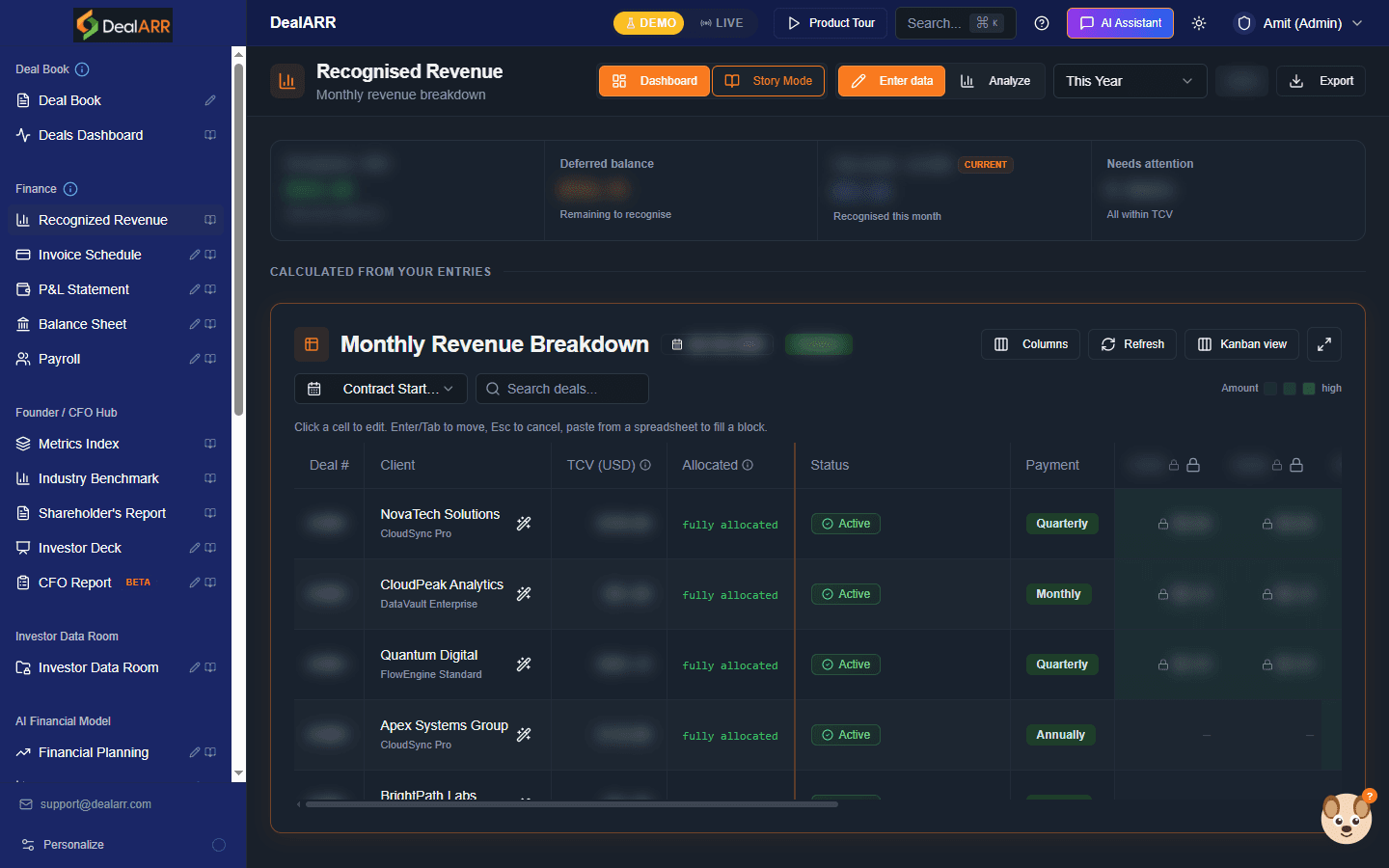
DealARR builds ASC 606 revenue schedules from your live contracts and reports recognized and deferred revenue every period, with no re-entry.
What Revenue Recognition Software Does
Revenue recognition software determines when contracted revenue counts as earned, then builds the schedule that spreads it across the service period. The revenue recognition principle holds that a business earns revenue as it delivers, not when it invoices, and the ASC 606 and IFRS 15 standards codify that. DealARR applies those standards to the contract data you already hold, which is what the automated revenue recognition below replaces.
Starts at the service date
DealARR recognizes revenue from the contract's service start date, not the invoice date. Billing a customer early or late stops distorting the accounting period.
Spread across the term
DealARR spreads deal value across the term, so revenue from a twelve-month deal signed mid-quarter earns across the right periods rather than landing in one.
Deferred balance updates
Anything billed but not yet earned sits in deferred revenue. DealARR releases it as each period closes, per contract and across the business.
Amendments re-spread forward
Upsells, co-terms, downgrades, and early renewals re-spread remaining revenue across the remaining term. Closed accounting periods stay untouched.
Automated Revenue Recognition from Live Contracts
Automated revenue recognition removes the re-entry step, because the schedule generates from the deal itself. Manual revenue accounting breaks in the same place every time: a deal gets amended, nobody re-spreads the schedule, and the close slips while one person rebuilds a tab. A solution that reads real deal data produces accurate financial statements without that failure mode.
ASC 606 revenue schedules
Per-contract schedules built from start date, end date, and value, so every period's recognized figure has a real contract behind it.
Deferred revenue tracking
See the deferred balance per customer and across the business, and watch it release period by period as revenue is earned.
Contracted vs. recognized
Contracted revenue sits beside recognized revenue, which is the gap that catches out any business reporting bookings as earnings.
Revenue waterfall reports
See how revenue on the book releases across future periods, so you know what a company has already earned and what remains.
Billings vs. revenue
Compare billings against recognized revenue in the same period, so invoice timing never gets mistaken for revenue growth in your financial statements.
Multi-year ramp deals
Complex ramped and multi-year deals earn revenue on their real step dates instead of being averaged into one flat line.
Recognized revenue in P&L
Recognized revenue flows into the profit and loss statement and the CFO report, so finance and the board read one figure.
Layer on top of your books
DealARR is the reporting layer, not a general ledger. It produces the schedules and balances your accounting team works from, while the books stay in QuickBooks. Those outputs are the revenue recognition tool data described next.
What a Revenue Recognition Tool Should Output
A revenue recognition tool should output the figures finance and the board actually ask for, not just a compliance tick. DealARR reports recognized revenue, deferred balances, billings, and backlog from the same contract data, so nothing needs tying back by hand at close. DealARR tracks 96 SaaS metrics in total, and finance teams read these first.
Who Uses DealARR for Revenue Recognition
Finance leaders, accounting teams, and founders facing diligence use DealARR for revenue recognition. Each one needs the same revenue reported correctly, before an audit, a fundraise, or a board question forces the issue. The data behind every answer is one deal book rather than three spreadsheets that drifted apart.
CFOs and finance leads
You report recognized and deferred revenue from the contracts themselves, so the numbers hold up when an auditor asks how you got them. Revenue schedules, profit and loss, and cash outlook all read from one accounting source.
Accounting and close teams
Month-end stops being a rebuild. Schedules already exist, amendments have re-spread, and the deferred balance is current, so the close becomes a review of revenue rather than a reconstruction of it from contract paperwork.
Founders facing diligence
When a fundraise starts, revenue questions arrive first. Contracted revenue, recognized revenue, and deferred balances come from one deal book, so diligence does not become a two-week spreadsheet excavation for your finance team.
Frequently Asked Questions
Common questions about revenue recognition software and how DealARR builds your schedules.
What is revenue recognition software?+
Does DealARR handle ASC 606?+
What is deferred revenue?+
Does DealARR post journal entries to my general ledger?+
How does it handle upsells and mid-term changes?+
What makes the best revenue recognition software for SaaS?+
How much does DealARR cost?+
Close the Month on Revenue You Can Trace
Connect your deal book and let DealARR build the revenue schedules. Every recognized and deferred figure traces back to a contract, a date, and a term your auditor can follow.
Start Free Trial30-day free trial · up to 5 users · no credit card